Lead Response Time: How Fast Follow-Up Turns Inquiries Into Customers
Lead response time can decide who wins the job. See what the research says and how contractors can answer inquiries faster and follow up without a call centre.
A homeowner spots a brown stain spreading across the bedroom ceiling on a Tuesday night. By 9:40 p.m. they’ve filled out quote forms on three roofing websites. The company that calls back first thing Wednesday morning books the inspection. The other two? One calls on Thursday afternoon. The other never calls at all.
That gap between someone asking for help and your business answering is your lead response time. For contractors and local service pros, it’s one of the cheapest problems to fix and one of the most expensive to ignore. You’ve already paid for that inquiry, whether through ads, SEO, a truck wrap or a referral you earned years ago. Letting it sit for a day is like leaving a deposit cheque on the dashboard and hoping it’s still there next week.
This guide looks at what the research says about response speed, where inquiries usually get lost in a busy trades business, and the practical habits that help you answer faster without hiring a call centre.
What the Research Says About Lead Response Time
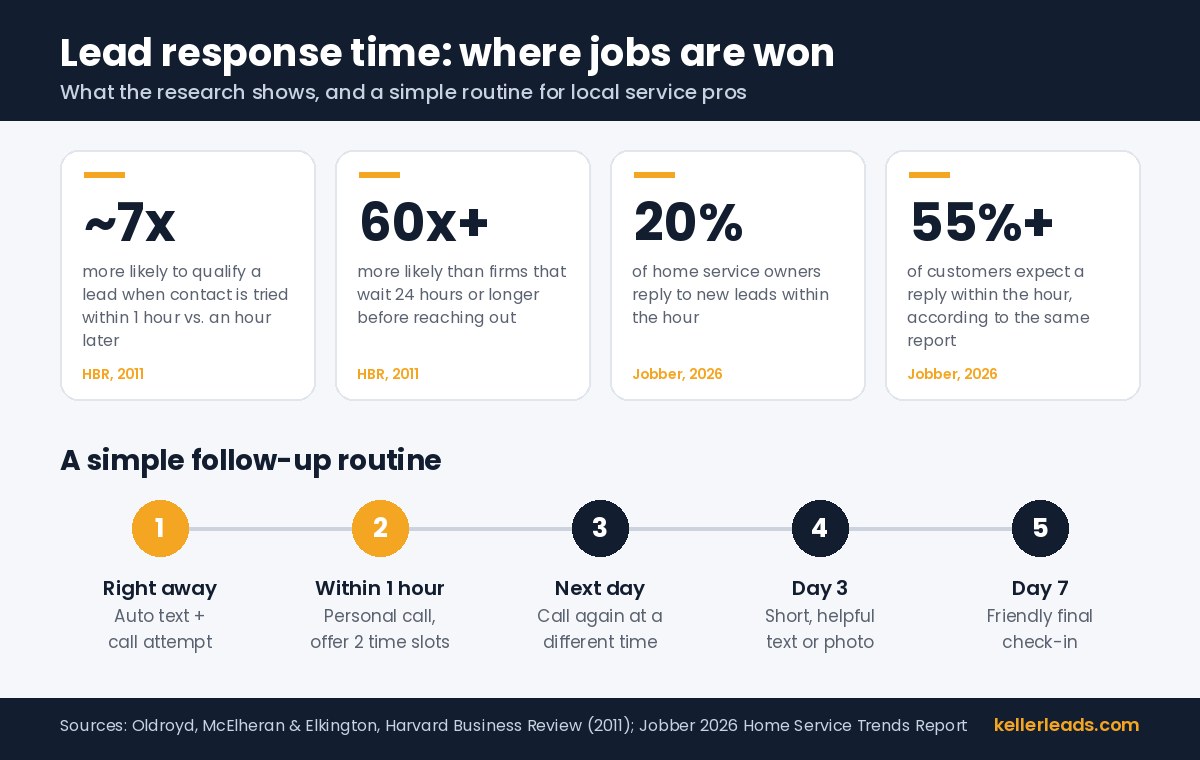
The most widely cited work on this comes from a study published in Harvard Business Review, “The Short Life of Online Sales Leads”. The researchers looked at 1.25 million sales leads received by 42 U.S. companies. Firms that tried to contact a prospect within an hour of receiving a query were nearly seven times as likely to qualify the lead (meaning they had a meaningful conversation with the decision maker) as firms that tried even an hour later. Compared with companies that waited 24 hours or longer, they were more than 60 times as likely.
The same authors also sent test inquiries to 2,241 U.S. companies. Only 37% responded within an hour. Almost a quarter never responded at all, and the average response time among those that did reply within 30 days was 42 hours.
That research is from 2011 and covers a broad mix of industries, not only the trades. More recent numbers from home services tell a similar story, though. Jobber’s 2026 Home Service Trends Report, based on a survey of 1,050 U.S. home service business owners, found that 60% reply to leads the same day but only 20% respond within the hour. HVAC businesses were the slowest group, with just 11% replying inside that window. The same report says more than 55% of customers expect a response within the hour, and 28% expect an immediate reply.
Put those findings side by side and the opportunity is obvious. Customers want an answer fast. Most service businesses don’t give them one. The contractor who closes that gap doesn’t need to be the cheapest or the biggest to win more work.
Why Fast Follow-Up Wins Jobs
Speed matters for reasons that go beyond simple politeness. A few things happen in a homeowner’s head when you call back quickly.
The first callback frames the job
The first contractor to have a real conversation gets to set the terms. You’re the one who asks the smart questions, explains what usually causes the problem and suggests a time to come out. By the time the second company calls, the homeowner may already have an appointment on the calendar, and every competitor after you is being compared with the experience you gave.
Urgent work goes to whoever answers
Plenty of service calls aren’t comparison shopping at all. No heat in January, a backed-up drain, a breaker that keeps tripping. Those customers usually book the first competent person who can give them a time. If your phone goes to a full voicemail box, that job is gone before you even see the missed call.
A slow reply looks like a preview of the job
Homeowners can’t easily judge workmanship before they hire you, so they judge what they can see. If it takes two days to get a callback about a quote, they start to wonder what happens when they need you to come back and fix something. A fast, organized reply suggests a business that shows up on time and finishes what it starts.
Where Inquiries Get Lost in a Typical Contractor Business
Most slow responses aren’t caused by laziness. They’re caused by how the business is set up. Look for these common leaks:
- The owner is the only person who answers. When you’re on a roof or under a sink, the phone stays in the truck. Calls stack up until the end of the day.
- Web forms go to an inbox nobody watches. Plenty of contact forms still send to an old info@ address that gets checked once a week, if that.
- Messages are scattered. Google Business Profile chats, Facebook messages, texts to a personal cell and emails all live in different places, so something always slips.
- Evening and weekend inquiries wait until Monday. Homeowners do a lot of their research after work. If nobody looks at those requests until the next business day, a competitor often beats you to it.
- Nobody owns the lead. In businesses with two partners or a small office team, everyone assumes someone else called the customer back.
How to Cut Your Lead Response Time Without Hiring a Call Centre
You don’t need a big budget to get faster. You need a simple system and the discipline to stick with it.
1. Measure it first
For two weeks, log every new inquiry in a spreadsheet: when it arrived, the channel, when someone first made contact, and whether it turned into an estimate. Don’t guess. Most owners believe they reply within an hour or two, and the real number is often closer to half a day. You can’t improve what you haven’t measured.
2. Route every inquiry to one place
Send web forms, missed-call alerts, Google Business Profile messages and social messages into a single place, whether that’s a CRM, a shared inbox or even a shared text thread for a small crew. Turn on push notifications for whoever is covering inquiries that day. Scheduling and dispatch tools can help here too. A good field service mobile app lets you see real availability, so you can offer a specific time slot on the first call instead of promising to “get back to you.”
3. Send an instant acknowledgment that sounds human
An automatic text the moment a form comes in buys you time and tells the customer they’ve reached a real business. Keep it short and specific:
“Hi Sarah, it’s Dave from Northside Roofing. Got your request about the ceiling leak. I’m on a job until 2 and will call you by 3 today. If it’s actively dripping, reply URGENT and I’ll call sooner.”
That message works because it sets a clear expectation and gives the customer a way to flag an emergency. Just remember that an auto-reply is a holding message, not a substitute for a conversation. If you promise a call by 3, call by 3.
4. Set a response window and give someone ownership
Pick a standard you can realistically hit, such as a personal reply within an hour during business hours, and assign who’s responsible for each part of the day. Maybe the office manager covers mornings and the owner takes over after lunch. A crew lead could handle Saturdays. Write it down so nobody assumes.
5. Make the first call count
Speed only helps if the conversation goes well. Keep a short checklist by the phone: the property address, what’s going on, how long it’s been happening, whether they can send photos, and their timeline. Then offer a specific appointment: “I can be there Thursday at 8 or Friday at 1. Which works better?” Two clear options book far more visits than “When’s good for you?”
6. Plan for after hours
If emergency work is part of your business, an answering service or a rotating on-call phone is worth the cost. If it isn’t, at least make sure after-hours inquiries get an automatic reply with a realistic callback time, and that someone works through them first thing the next morning. If you run paid ads at times when nobody can answer, it’s worth reviewing that schedule as well.
Follow-Up: The Part Most Contractors Skip
A fast first response gets you into the conversation. Follow-up is what turns it into a signed job. Plenty of homeowners don’t pick up the first time, and plenty of estimates sit unanswered simply because the customer got busy.
A simple cadence for new inquiries you haven’t reached yet might look like this:
- Right away: call, then send a text if they don’t answer.
- Next day: call again at a different time of day.
- Day three: send a short, helpful text, perhaps a photo of a similar job or a tip about the problem they described.
- About a week later: one final check-in, letting them know you’re happy to help whenever they’re ready.
After you’ve sent an estimate, follow up within a couple of days to answer questions. Keep the tone helpful rather than pushy. “Did you have any questions about the options in the quote?” lands much better than “Just checking if you’ve made a decision yet.”
Tracking Whether Faster Follow-Up Is Paying Off
Once you’ve tightened your process, keep watching a handful of numbers each month:
- Time to first response, ideally your median rather than the average, so one weekend miss doesn’t skew everything.
- Contact rate: the share of inquiries where you actually spoke with the customer.
- Booked estimate rate: how many of those conversations turned into a site visit.
- Close rate by lead source, so you can see which channels are worth the money.
Response speed is only one piece of a healthy pipeline, of course. If you’re still building the channels that bring inquiries in, our guide to contractor lead generation tactics for local service pros covers Google Business Profile, reviews, websites and paid lead sources in more detail.
Final Thoughts on Lead Response Time
Improving your lead response time doesn’t call for fancy software or a bigger marketing budget. It means treating every inquiry like money you’ve already spent, because you have. Measure how long you really take to reply, put every inquiry in one place, send a quick acknowledgment, and make sure someone owns the callback. Then keep following up until you get an answer. Do that consistently and you’ll win jobs that used to go to whoever simply picked up the phone first.
About The Author