How to Get More Google Reviews for Your Local Business (Without Breaking the Rules)
A practical, rule-friendly system to get more Google reviews for your local business: when to ask, how to ask, what Google and Canadian regulators prohibit, and how to reply.
A plumber finishes a water heater swap at 4:15 on a Friday. The homeowner is thrilled: hot showers are back, the old tank is gone, the garage floor is cleaner than it was before the crew arrived. She says, “You guys were great, I’ll definitely leave you a review.” Then the weekend happens. Then Monday. The review never shows up.
That’s not a customer problem. It’s a process problem. Most happy customers fully intend to say something nice about you online, and most of them never get around to it. If you want more Google reviews for your local business, the work is less about persuasion and more about removing friction at the right moment, while staying inside the rules that Google and Canadian regulators actually enforce.
Why Google Reviews Matter So Much for Local Service Businesses
When someone searches “furnace repair near me” or “roofer in Hamilton,” the map results are often the first thing they see. Your star rating and review count sit right next to your business name, before anyone clicks through to your website. In practice, reviews do three jobs at once:
- They help you get chosen. A homeowner comparing three electricians will usually lean toward the one with recent, detailed feedback from people in their area.
- They support local visibility. Google’s own guidance lists review count and rating among the signals that can influence how prominent a business is in local results.
- They pre-sell the job. A review that says “they showed up on time, put down drop cloths and explained the quote line by line” answers objections before your estimator ever picks up the phone.
Reviews also compound. Every new one feeds the visibility that brings in the next customer, which is exactly why it’s worth turning review requests into a habit rather than an occasional burst of effort. If you’ve already been working on contractor lead generation tactics, reviews are the piece that makes those other channels convert better.
Know the Rules Before You Ask
It’s tempting to skip this section. Don’t. A handful of common “growth hacks” can get reviews removed, trigger profile restrictions, or create legal exposure.
What Google prohibits
Google’s prohibited and restricted content policy covers reviews on Maps and Business Profiles. A few points trip up small businesses more than others:
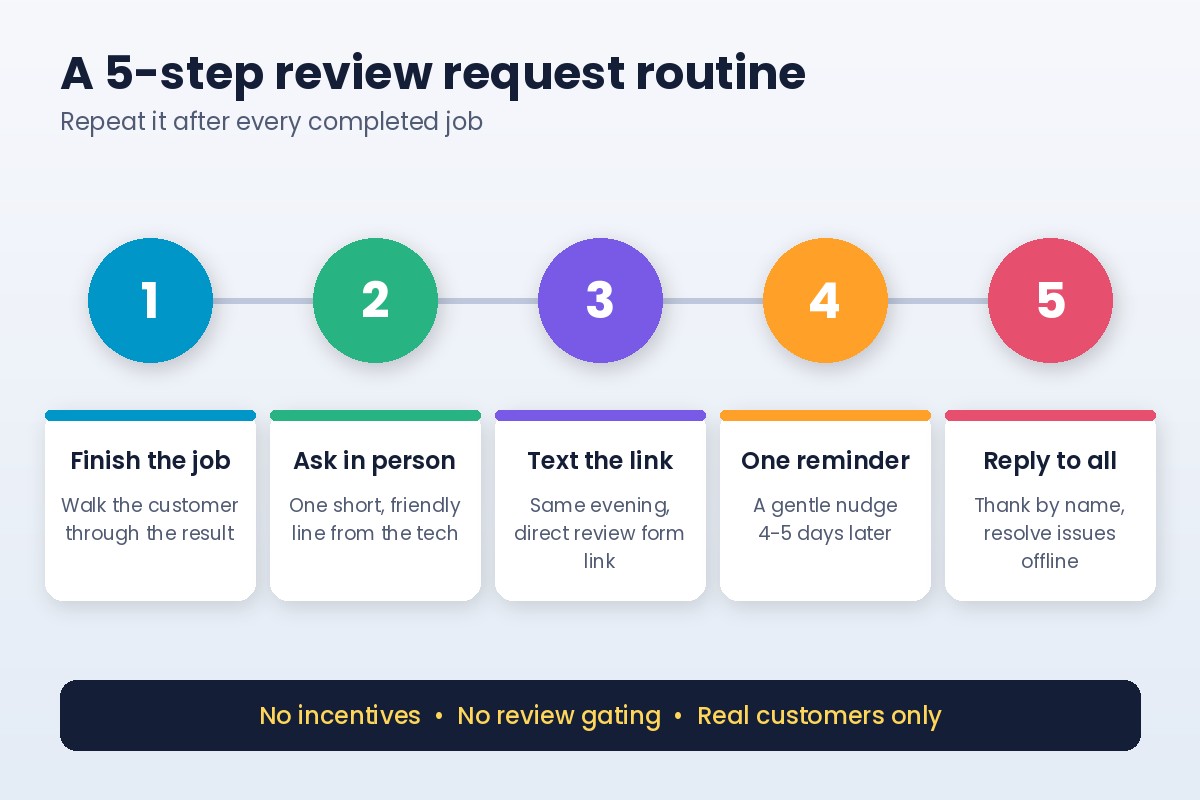
- No incentives. You can’t offer a discount, gift card, draw entry or free service in exchange for a review, even if you don’t specify that it must be positive.
- No review gating. Sending a “How did we do?” survey first and only forwarding happy customers to Google is not allowed. Everyone gets the same invitation.
- No self-reviews or staff reviews. Owners, employees and family members shouldn’t be reviewing the business.
- No bulk-buying or review swaps. Paid review services and “I’ll review you if you review me” arrangements with other businesses both count as fake engagement.
What Canadian law adds
In Canada, the Competition Bureau treats fake or misleading reviews as a deceptive marketing issue under the Competition Act. In a January 2024 notice, the Bureau specifically warned businesses that they could be liable for reviews posted by employees who don’t disclose their connection to the company. The safest approach is simple: only real customers review you, and nobody is rewarded for doing it.
Honest reviews also read differently. They mention neighbourhoods, technicians by name, the specific job. Buyers can tell.
When to Ask: Timing Is Most of the Battle
The best moment to ask is when the customer feels the result, not when you send the invoice. For most trades, that’s one of three points:
- At job completion, in person. The tech walks the homeowner through the finished work, they say “this looks great,” and that’s the cue.
- Within a few hours by text. A short message the same day, while the experience is fresh, gets far better response than a generic email a week later.
- After a milestone on longer projects. For a kitchen renovation or a basement finish, don’t wait three months for final sign-off. Ask after a visible milestone the client was excited about, then again at completion if they didn’t respond.
Avoid asking during moments of friction: right after a change order, when an invoice is disputed, or while a callback is still open. Fix the issue first. A customer who saw you make something right is often your most persuasive reviewer.
How to Ask: Make It a Ten-Second Task
Every extra tap loses people. If a customer has to search for your business, find the right listing, scroll to the reviews section and figure out where the button is, a good share of them will give up halfway.
Get your direct review link
Inside your Business Profile, Google provides a shareable link and QR code that open the review form directly. Google explains where to find it in its tips to get more reviews. Save that link somewhere your whole team can reach it: your CRM, your text templates, the back of your business cards.
Use a short script your team actually likes
Techs and installers aren’t salespeople, and a stiff script will either get skipped or sound awkward. Give them something short and human:
“Glad we could get that sorted today. We’re a local business and Google reviews really help people find us. I’ll text you a link tonight. If you’ve got a minute, a quick note about how today went would mean a lot.”
Then send the follow-up text that same evening:
“Hi Priya, it’s Mark from Northline Plumbing. Thanks again for having us out today. If you’re happy with the new water heater, here’s the link to leave a quick Google review: [link]. Appreciate it!”
Notice what’s missing: no “five-star” request, no pressure, no reward. Just a clear, easy ask from a real person.
Put the QR code where customers already look
A small QR card left on the counter with the paperwork, a sticker on the furnace you just installed, a line on the final invoice. These physical reminders work well for customers who prefer not to click links in text messages.
Build the Ask Into Your Workflow
The businesses with steady review growth aren’t more charming than everyone else. They’ve simply made the request automatic, so it happens on every job instead of whenever someone remembers.
- Trigger it from job status. Most field service and CRM tools can send a templated text when a job is marked complete. Set it to go out two or three hours later, not instantly.
- Send one reminder, not five. A single gentle nudge four or five days later is reasonable. Beyond that, you’re nagging.
- Track requests against reviews. If you sent 60 requests last month and got 9 reviews, you have a baseline. Change one thing (the wording, the timing, who sends it) and watch whether the number moves.
Speed matters here the same way it does with new inquiries. Just as quick follow-up wins jobs (we covered that in our piece on lead response time), a fast review request catches customers while their satisfaction is at its peak.
Respond to Every Review, Including the Bad Ones
Replying to reviews shows future customers that someone is paying attention. It also signals to the reviewer that their time was worth something.
Positive reviews
Keep it short and specific. Thank them by first name, mention the job, and if it fits naturally, reference the area you work in. “Thanks, Dan. Glad the new sump pump kept the basement dry through last week’s storm” beats a copy-pasted “Thank you for your kind words!” every time.
Negative reviews
Take a breath before replying. Then:
- Acknowledge the experience without arguing about details in public.
- Take responsibility where it’s fair to.
- Offer a direct way to resolve it: a name and a phone number, not a generic inbox.
- Follow through, and if the customer ends up satisfied, they may choose to update their review on their own.
Never offer compensation in exchange for removing or changing a review. That falls under the same incentive rules mentioned above. Fix the problem because it’s the right thing to do, and let the customer decide what to say afterward.
Flagging reviews that break the rules
If a review is clearly from someone who was never a customer, contains harassment, or comes from a competitor, you can flag it for removal through your Business Profile. Keep records: job lists, dates, any messages. Google won’t remove a review just because it’s negative, so focus on policy violations, not disagreements.
Common Mistakes That Stall Review Growth
- Asking in batches. Emailing your entire customer list once a year produces a spike, then silence. A sudden cluster of reviews can also look unnatural. Steady beats sporadic.
- Only asking “good” customers. Choosing who gets the link based on how happy you think they are drifts into gating territory. Ask everyone after every completed job.
- Ignoring older reviews. A profile whose most recent review is from two years ago raises questions. Recency matters to buyers.
- Treating reviews as a marketing task only. The office can set up templates, but the request lands best when it starts with the person who did the work.
A Simple 30-Day Plan to Get Started
If your profile has been quiet, here’s a realistic way to restart without overwhelming anyone:
- Week 1: Grab your direct review link and QR code. Write one text template and one in-person line. Print a small stack of QR cards.
- Week 2: Brief the field team. Ask every customer whose job closes this week. Reply to any existing reviews you haven’t answered.
- Week 3: Automate the post-job text in your CRM or scheduling tool. Add the review link to your invoice footer.
- Week 4: Count requests sent and reviews received. Share a few standout reviews with the team and adjust anything that felt clunky.
None of this is complicated. The difference between a business with 14 reviews and one with 140 is rarely the quality of the work. It’s that one of them asks every single time, makes it easy, and keeps going after the novelty wears off.
Final Thoughts
Learning how to get more Google reviews for your local business comes down to a few steady habits: ask every customer, ask at the right moment, make the link effortless, and reply like a person. Stay clear of incentives, gating and fake reviews, and the profile you build will hold up for years. Start with your next completed job. The homeowner who just got her hot water back is probably happy to help. She just needs you to make it easy.