Drywall Taping Tool Set: Building an Efficient Finishing System
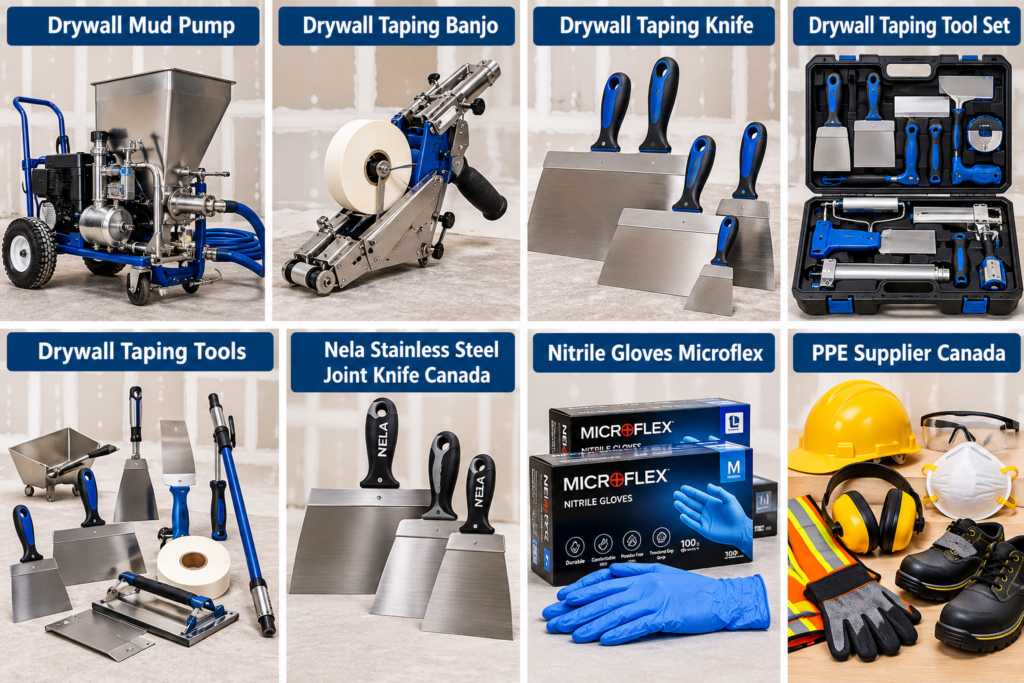
Professional drywall finishing involves far more than applying compound to a seam. Flat joints, internal corners, fasteners, tape application, material loading, and final coating each present different challenges. A drywall taping tool set brings complementary equipment together to create a coordinated workflow.
Instead of treating every task as an isolated step, a complete setup allows finishers to move through projects systematically.
What Can a Drywall Taping Tool Set Include?
The exact contents vary depending on the intended workflow.
A drywall taping tool set may contain equipment for applying tape, finishing flat joints, coating corners, loading compound, extending reach, or handling other repetitive tasks.
The key idea is compatibility. Each component supports a different part of the finishing process.
The Advantage of a System
Buying or using individual tools without considering the overall workflow can lead to unnecessary interruptions.
A drywall taping tool set encourages workers to think about the entire finishing sequence.
Taping
The first stage establishes taped seams and corners.
Equipment designed for efficient tape and compound application can reduce repetitive manual work on larger projects.
Flat Joint Finishing
After the taped joints are ready, finishing tools can help distribute subsequent coats consistently across seams.
Different widths may be useful as the joint becomes broader.
Corner Finishing
Inside corners require their own approach. Specialized equipment can help distribute and smooth compound along angles.
Loading
Finishing tools also need an efficient source of joint compound. A coordinated drywall taping tool set may support faster, cleaner material loading.
Who Needs a Complete Set?
Not every user needs the same level of equipment.
Someone completing occasional patches may prefer individual hand tools. A contractor regularly finishing full properties may gain significantly more value from a comprehensive drywall taping tool set.
Project frequency matters just as much as project size.
A professional who finishes drywall every week will experience repetitive tasks far more often than someone completing a single renovation.
Consider the Work You Perform
Before choosing equipment, examine your typical projects.
Do you handle mostly residential interiors? Are high ceilings common? Do projects include numerous corners? How much flat-joint footage do you finish regularly?
Answers to these questions can help determine which components of a drywall taping tool set are most relevant.
Learning the Equipment
A complete set can improve productivity only when users understand each tool.
Trying to master everything simultaneously may be frustrating. Instead, learn the workflow in stages.
Start With Core Operations
Develop confidence with loading, taping, and straightforward flat joints.
Once those movements become consistent, introduce corner finishing and other specialized operations.
Focus on Quality Before Speed
Automatic equipment can move quickly, but speed should come after control.
A drywall taping tool set delivers the greatest benefit when the user can produce repeatable results without frequent corrections.
Organization on the Job Site
Having multiple tools creates another responsibility: organization.
Establish a dedicated area for the drywall taping tool set, compound, cleaning supplies, and related equipment.
Return tools to that area when they are not being used.
This reduces time spent searching for components and helps protect equipment from accidental damage.
Maintenance Should Be Part of the Routine
Joint compound is easy to manage while wet and much harder to remove once fully dried.
Clean every component that contacts compound after use.
Do not treat maintenance as a separate optional task. Make it part of the finishing workflow.
Inspect Moving Components
Look for dried residue, loose hardware, damaged seals, worn contact surfaces, or anything else that could affect performance.
Preventive attention can reduce interruptions during future projects.
Balancing Automatic and Hand Tools
A drywall taping tool set does not eliminate the usefulness of traditional hand tools.
Knives and other manual finishing equipment remain valuable for detail work, corrections, tight spaces, and final touch-ups.
The most efficient workflow often combines automatic equipment for repetitive areas with hand tools for precise adjustments.
Long-Term Productivity
The greatest benefit of a drywall taping tool set often appears over repeated projects.
Saving a small amount of time on one seam may seem insignificant. Multiply that efficiency across hundreds of joints, multiple rooms, and many projects, and the difference becomes substantial.
Consistency can also reduce the time spent correcting avoidable application problems.
Conclusion
A drywall taping tool set provides a coordinated approach to drywall finishing by bringing specialized functions into one workflow.
The right setup depends on project volume, working conditions, and the user’s experience. Simply owning more equipment does not guarantee better results.
Learn each component, maintain tools carefully, organize the job site, and prioritize consistent technique. With those habits in place, a drywall taping tool set can help transform a repetitive finishing process into a more structured and productive system.
About The Author